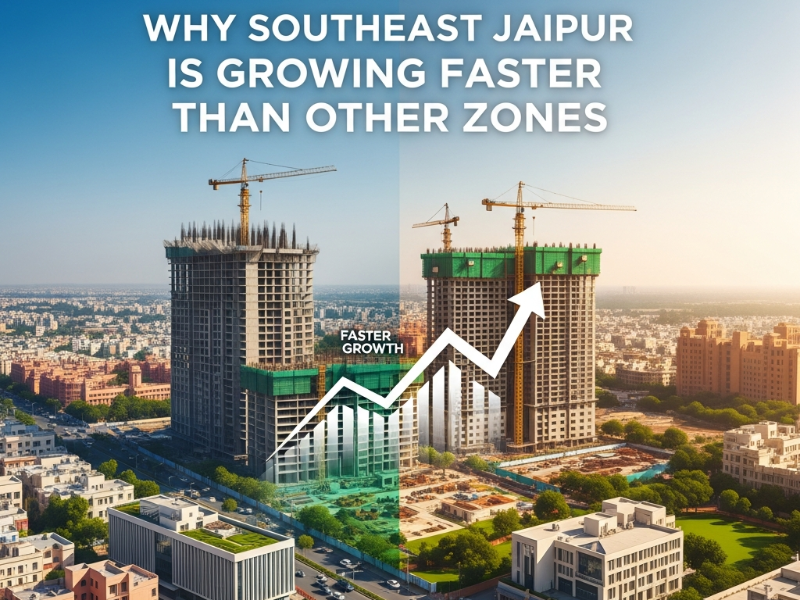
Jaipur’s real estate landscape is experiencing explosive growth, with the city recording a remarkable 98.2% property price increase—the highest among all Tier-2 cities in India. However, this growth isn’t uniform across the city. Southeast Jaipur, particularly areas like Jagatpura and the Tonk Road corridor, is outpacing all other zones in development velocity, property appreciation, and infrastructure investment. While established areas like Malviya Nagar and C-Scheme show steady but modest growth, and western zones like Vaishali Nagar remain stable, southeast Jaipur is witnessing a transformation comparable to what Pune’s Hinjewadi or Bangalore’s Whitefield experienced a decade ago. Understanding the factors driving this disproportionate growth helps buyers and investors recognize why southeast Jaipur represents Jaipur’s most compelling real estate opportunity in 2025.
Key Factors Driving Southeast Jaipur’s Accelerated Growth:
- Strategic Proximity to Sitapura Industrial Area: Southeast Jaipur’s single biggest advantage is its proximity to Sitapura Industrial Area and the Mahindra SEZ—massive employment generators housing IT companies, manufacturing units, logistics firms, and corporate offices. This employment hub creates sustained housing demand from working professionals seeking minimal commute times. Areas like Jagatpura benefit directly from this proximity, with consistent rental demand and strong appreciation driven by organic employment-based housing needs rather than speculative investment. The ongoing expansion of Sitapura and the Kotputli-Agra Greenfield Expressway transforming the zone into a commercial hub ensures this employment-driven demand will intensify through 2030 and beyond.
- Superior Infrastructure Investment and Connectivity: Southeast Jaipur receives disproportionate infrastructure spending compared to other zones. The ₹12,000 crore Metro Phase II project specifically targets this corridor, connecting Sitapura to Ambabari via Jagatpura with completion targeted for 2030. The Northern Ring Road provides direct connectivity to national highways, eliminating the need to traverse congested central Jaipur. The Jagatpura Elevated Corridor eases traffic toward Tonk Road, while the revamped Solo Circle enables seamless movement to commercial areas. Road widening projects under Master Plan 2025 are creating 71 new sector roads, many concentrated in this southeastern growth corridor. This infrastructure concentration isn’t accidental—government planners recognize southeast Jaipur as the city’s primary expansion direction and are investing accordingly.
- Affordable Entry Points with Premium Amenities: Unlike saturated zones like Malviya Nagar where properties command ₹6,000-₹7,600 per square foot, southeast Jaipur offers significantly lower entry costs while delivering comparable lifestyle benefits. Jagatpura properties range from ₹3,750-₹5,700 per square foot, representing 30-40% discounts versus established areas. Despite this affordability gap, the zone offers comprehensive social infrastructure—quality schools like SRN International and Divine Academy, hospitals including Narayana Multispecialty Hospital, and retail destinations like Vivacity Mall. This value arbitrage attracts first-time homebuyers, young families, and investors seeking maximum appreciation potential at accessible price points.
- Fastest Appreciation Rates in the City: The numbers tell a compelling story. Jagatpura has demonstrated 20-25% annual appreciation in prime pockets, with land rates rising 95.5% over five years and apartments appreciating 53.3% in the same period. Some premium projects delivered 68.8% appreciation in just one year. Current data shows Jagatpura at ₹10,800 per square meter, while the Ajmer Road corridor—another southeast zone hotspot—commands ₹18,000 per square meter with 26.3% year-over-year growth. These appreciation rates consistently exceed established northern and western zones where growth has stabilized at modest 6-10% annually. Investors purchasing in southeast Jaipur five years ago have seen their investments nearly double, returns impossible to achieve in mature areas.
- Master Plan 2025 Designates Southeast as Growth Corridor: The JDA Master Plan 2025 explicitly identifies southeast Jaipur as a priority development zone with planned satellite towns and growth centers designed to ease pressure on the overcrowded city core. This official designation ensures continued infrastructure investment, zoning favorable to residential development, and civic amenity provision that supports population growth. The master plan’s vision includes mixed-use developments combining residential, commercial, and recreational spaces—a model perfectly suited to southeast corridors like Tonk Road where JDA and RERA-approved plots range from ₹29,000-₹60,000 per square yard.
- Educational and Healthcare Hub Development: Southeast Jaipur has emerged as an educational corridor with multiple universities and schools including ISBM University, Manipal University, MC India International School, and numerous coaching centers attracting students from across Rajasthan. This educational concentration creates rental demand from students, faculty housing needs, and attracts families prioritizing education access. The zone’s healthcare infrastructure has expanded dramatically with Narayana Multispecialty Hospital, Fortis Hospital, and the upcoming Bombay Hospital project. These institutional anchors provide employment, attract families, and enhance overall livability—creating virtuous cycles where infrastructure attracts residents who demand more services, spurring further development.
- Developer Confidence and Premium Project Launches: Real estate developers serve as bellwethers for growth potential—they invest where research indicates strong demand and appreciation. Southeast Jaipur has witnessed concentrated activity from established developers including Mahima Group, Ashadeep Group, Vardhman Group, and Ashiana Housing launching premium projects. Developments like Mahima Panache, Ashadeep Vedanta, and Ashiana ONE44 target upper-middle-class families with comprehensive amenities previously unavailable in this corridor. This developer activity signals confidence in long-term growth and creates a self-fulfilling prophecy as luxury projects elevate neighborhood profiles and attract affluent buyers who wouldn’t have considered the area previously.
- Airport Connectivity Advantage: Jagatpura’s proximity to Jaipur International Airport provides significant advantages as air travel becomes increasingly accessible. The airport’s ongoing expansion enhances domestic and international connections, making Jaipur a growing business and tourism hub. For business travelers, NRIs, and frequent flyers, minimizing airport travel time is paramount. Southeast locations offering 20-30 minute airport access command premiums over distant northwestern or northern zones requiring 60+ minute commutes through traffic. This connectivity advantage will appreciate further as Jaipur’s airport handles increasing passenger volumes and as business travel resumes post-pandemic momentum.
- Less Congested, More Livable Environment: While central and western Jaipur face increasing congestion, traffic bottlenecks, and infrastructure strain from decades of dense development, southeast Jaipur offers relatively uncongested roads, planned layouts with adequate open spaces, and modern infrastructure built to accommodate growth. Families increasingly prioritize livability over mere proximity to traditional city centers—they want spaces where children can play safely, commutes remain manageable, and daily life isn’t consumed by traffic stress. Southeast Jaipur delivers this quality of life while maintaining connectivity to employment and amenities, making it particularly attractive to young families and professionals who grew up in congested older neighborhoods and want better environments for their children.
Comparative Analysis with Other Jaipur Zones:
Northern zones like Vidyadhar Nagar and Civil Lines remain stable but show limited growth due to development saturation and lack of large-scale new projects. Western zones like Vaishali Nagar represent established premium areas with consistent but modest appreciation—their maturity limits upside potential. Northwestern corridors including Sikar Road offer affordability but lack the employment proximity and infrastructure investment driving southeast growth. Central areas like C-Scheme maintain prestige and value but face space constraints, aging infrastructure, and negligible appreciation given already-premium pricing.
In contrast, southeast Jaipur combines affordable entry points with aggressive infrastructure development, employment hub proximity, and genuine growth catalysts creating sustainable appreciation trajectories. The zone hasn’t peaked—it’s still climbing, offering investors the sweet spot of reduced risk through visible infrastructure progress while maintaining substantial upside potential as projects complete and neighborhoods mature.
Investment Timing and Future Outlook:
The optimal investment window for southeast Jaipur is narrowing but remains open. Current prices still offer 30-40% discounts versus established areas, but this gap will close as infrastructure projects near completion. The Metro Phase II, targeted for 2030, represents a key inflection point—properties near planned metro stations will likely see 25-40% appreciation jumps once operations begin. Investors entering today can capture appreciation through the construction phase and the operational launch premium.
Beyond 2030, southeast Jaipur’s growth trajectory remains strong. The Delhi-Mumbai Expressway opening positions Jaipur within three hours of Delhi, potentially attracting NCR buyers seeking better living costs. Sitapura’s continued expansion as an employment hub ensures sustained housing demand. The zone’s relatively young demographic profile—young professionals, families with children—indicates long-term stability as these residents age in place while new cohorts continue arriving for employment and education opportunities.
Southeast Jaipur’s accelerated growth isn’t a temporary phenomenon or speculative bubble—it’s the result of converging fundamentals including employment proximity, strategic infrastructure investment, affordability advantages, and government planning designating the zone for expansion. While other Jaipur zones offer stability or prestige, southeast areas like Jagatpura, Tonk Road, and the Sitapura corridor offer something more valuable—genuine transformation creating wealth-building opportunities for those who recognize potential before it becomes consensus. Whether you’re a first-time homebuyer seeking quality living at accessible prices, a family prioritizing education and healthcare access, or an investor pursuing maximum appreciation, southeast Jaipur deserves serious consideration as Jaipur’s most dynamic and promising real estate zone in 2025 and beyond.