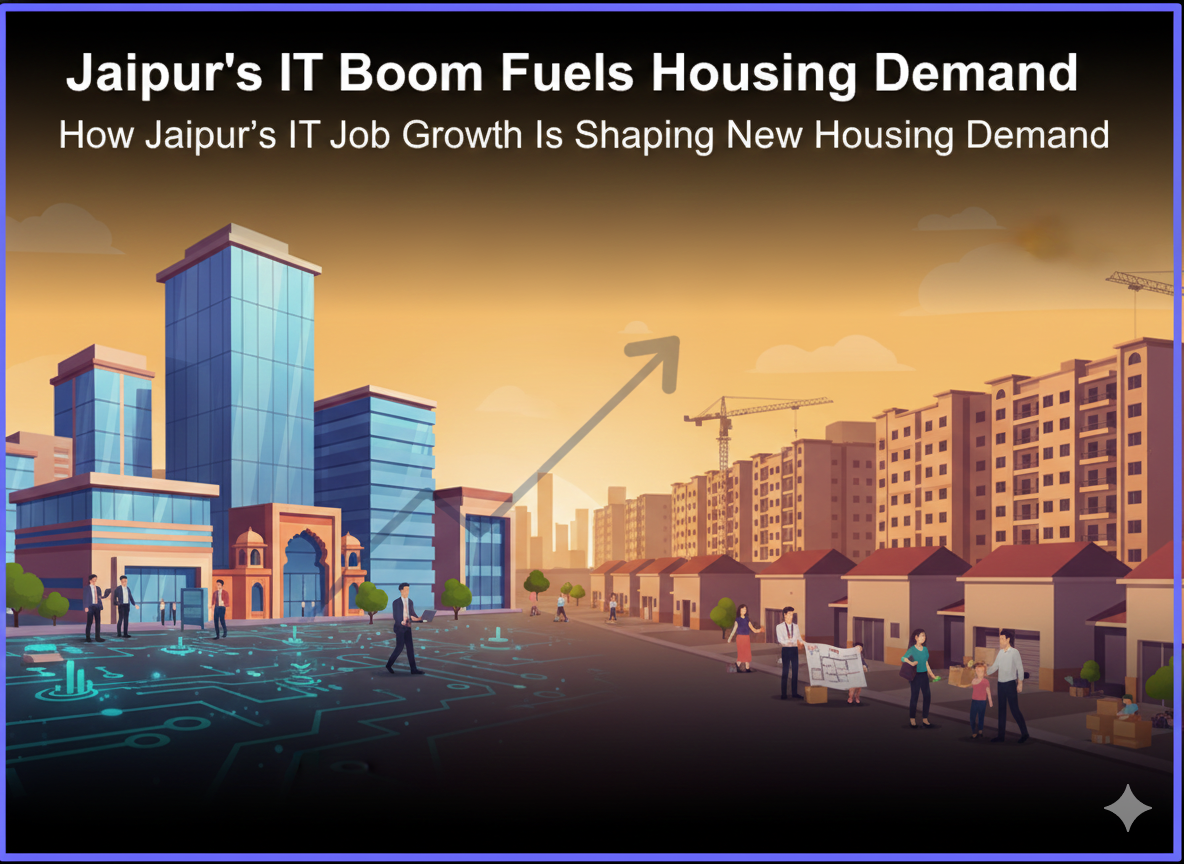
Jaipur is rapidly transforming from a heritage tourism destination into a thriving IT and technology hub, fundamentally reshaping the city’s housing demand patterns. The Pink City has secured the top position in junior-level IT hiring among Tier-2 cities, accounting for 18.18% of total IT jobs, while ranking first in senior-level hiring at 20.78%. This explosive IT sector growth, projected at 25% annually since 2022, is creating unprecedented housing demand that’s driving real estate development in specific corridors and changing the profile of homebuyers across the city. Understanding this transformation helps buyers, investors, and developers recognize where Jaipur’s residential market is headed and why certain neighborhoods are experiencing disproportionate appreciation.
The Scale of Jaipur’s IT Sector Expansion:
Jaipur’s emergence as an IT powerhouse isn’t accidental—it’s the result of strategic government initiatives, favorable business environment, and growing talent pools. Global Capability Centers are expanding aggressively into Tier-2 cities like Jaipur, driven by significantly lower real estate costs, operational expenses, and salaries compared to Tier-1 metros. These locations offer large, untapped talent pools with lower attrition rates, contributing to more stable workforces supported by better lifestyle factors. In 2026, Tier-2 cities like Jaipur will play an even more central role as organizations embrace multi-location talent models for resilience and cost optimization.
The Rajasthan government has actively supported this growth through the expansion of Software Technology Parks of India in Jaipur, fostering innovation hubs, and providing tax incentives and infrastructure support. Programs like Digital Rajasthan, Smart City initiatives, and the Rajasthan IT and Startup Policy are pushing investment into the tech sector, attracting both domestic and international IT companies. The government’s focus on creating a conducive environment for employment generation has transformed areas like Mahindra World City, Sitapura Industrial Area, and RIICO Zones into major business attractions, translating to higher rental yields and sustained demand for housing near these locations.
Key IT Employment Hubs Driving Housing Demand:
Several strategic zones have emerged as IT employment magnets, each creating distinct housing demand patterns in surrounding residential areas. Sitapura Industrial Area, established in 1990 and Jaipur’s second-largest industrial zone spanning 419 acres with 853 plots, has evolved beyond traditional manufacturing into a hub for IT companies, BPO operations, and SEZ zones for jewelry exports. Located just 5 km from Sanganer railway station with excellent connectivity via Tonk Road, Sitapura employs thousands of IT professionals who seek housing within short commuting distances. This employment concentration has driven explosive residential development in Jagatpura, which offers proximity to Sitapura while providing modern amenities and comprehensive social infrastructure.
Mahindra World City represents another major employment generator attracting IT and manufacturing companies to its 3,000-acre SEZ near Jaipur. The development provides world-class facilities and infrastructure, creating employment opportunities that fuel housing demand in surrounding areas. The Kotputli-Agra Greenfield Expressway is further transforming this corridor into a commercial hub, ensuring sustained employment growth through 2030 and beyond.
How IT Professionals Are Reshaping Housing Preferences:
The influx of IT professionals into Jaipur’s employment market has fundamentally altered housing demand characteristics. With Millennials and Gen Z forming nearly 90% of the workforce, employee expectations are reshaping what housing must deliver. These demographics prioritize flexibility, learning pathways, rapid career growth, and work-life balance as much as compensation—expectations that translate directly into housing preferences.
IT professionals seek apartments with dedicated home office spaces or flex rooms accommodating hybrid work models. High-speed fiber-optic internet connectivity isn’t a luxury—it’s a non-negotiable requirement for remote work, video conferences, and digital collaboration. Properties lacking robust digital infrastructure face lower demand and rental yields compared to tech-ready developments. Smart home features including automated lighting, climate control, and security systems appeal strongly to tech-savvy buyers who expect their living spaces to match their professional technological sophistication.
Location preferences have also shifted dramatically. While previous generations prioritized proximity to city centers, IT professionals focus on proximity to employment hubs like Sitapura, commute time minimization, and access to comprehensive amenities within residential complexes. Areas like Jagatpura, which offer 15-20 minute commutes to Sitapura while providing quality schools, hospitals, retail destinations, and recreational facilities, have experienced 20-25% annual appreciation as IT professionals flood the rental and purchase markets.
Specific Neighborhoods Benefiting from IT Growth:
The correlation between IT employment hubs and residential real estate appreciation is clear and measurable. Jagatpura has emerged as the primary beneficiary of Sitapura’s IT expansion, with property prices rising 53.3% for apartments and 95.5% for land over five years. Current apartment rates of ₹3,750-₹5,700 per square foot remain 30-40% below established areas like Malviya Nagar, yet appreciation rates consistently exceed those mature locations due to organic employment-driven demand. Premium projects by established developers including Mahima Group, Ashadeep Group, and Vardhman Group have launched in Jagatpura specifically targeting IT professionals seeking quality living near employment centers.
The Tonk Road corridor, connecting central Jaipur to Sitapura, has witnessed commercial and residential transformation. Properties along this arterial route command ₹18,000 per square meter with 26.3% year-over-year growth, reflecting demand from professionals wanting balanced access to both traditional city amenities and new-age employment zones. Ajmer Road, benefiting from the SEZ belt and improving infrastructure, attracts IT professionals seeking affordable entry points with strong appreciation potential.
Even established areas like Malviya Nagar and Vaishali Nagar are experiencing renewed demand, though at more modest appreciation rates, as senior IT professionals and management-level employees seek premium residential environments with comprehensive social infrastructure. The demographic diversity created by IT sector growth—from junior developers to senior architects and project managers—ensures housing demand across multiple price segments and neighborhoods.
Rental Market Transformation:
Perhaps the most visible impact of IT job growth is on Jaipur’s rental market. Areas near IT hubs experience consistent rental demand with minimal vacancy periods, delivering yields of 3-4% annually—attractive returns in India’s residential market. Jagatpura properties rent quickly to Sitapura employees, students from nearby universities, and young professionals who prioritize proximity over ownership. Landlords report that IT professional tenants prefer well-maintained properties with modern amenities, proper parking, and reliable internet, willingly paying 10-15% premiums over basic apartments lacking these features.
The rental demographic has also matured. Unlike traditional Jaipur renters who were primarily students or single professionals, IT sector growth has created demand from families relocating for employment, couples seeking quality living before purchasing, and professionals on project-based assignments requiring flexibility. This demographic stability improves landlord confidence and justifies investment in rental property quality and amenities.
Future Outlook and Investment Implications:
The trajectory of IT job growth in Jaipur shows no signs of slowing. The city’s IT sector is projected to grow 15-20% throughout 2025, with specialized roles in AI, machine learning, data analytics, and cloud technologies experiencing 30-35% growth. Global Capability Centers, manufacturing companies, banking institutions, healthcare organizations, and retail sectors will boost their IT fresher intake by 30-35% in 2025, creating thousands of new positions requiring housing accommodation.
This sustained employment growth ensures continued residential real estate demand through multiple economic cycles. Areas positioned near current and planned IT hubs—Jagatpura, Sitapura corridor, Tonk Road, and zones benefiting from upcoming Metro Phase II connectivity—offer compelling investment opportunities for those seeking appreciation driven by fundamental demand rather than speculation. Properties with tech-ready infrastructure, modern amenities, and proximity to employment centers will consistently outperform generic developments lacking these attributes.
For developers, understanding IT professional preferences—flexible spaces, smart features, community amenities, sustainability—guides project design toward market relevance. For investors, focusing on corridors experiencing IT-driven employment growth provides organic rental demand and capital appreciation. For homebuyers, choosing locations with strong IT employment proximity ensures long-term value retention and superior lifestyle quality.
Jaipur’s IT job growth isn’t just creating employment—it’s fundamentally reshaping where people want to live, what features they demand in homes, and how much they’re willing to pay for convenience and quality. The transformation from heritage city to technology hub has permanently altered Jaipur’s housing demand landscape, creating opportunities for those who recognize that employment drives residential real estate more powerfully than any other single factor. As thousands of IT professionals continue arriving in Jaipur each year seeking careers in this booming sector, the housing demand they generate will sustain real estate growth across strategic corridors well into the next decade.