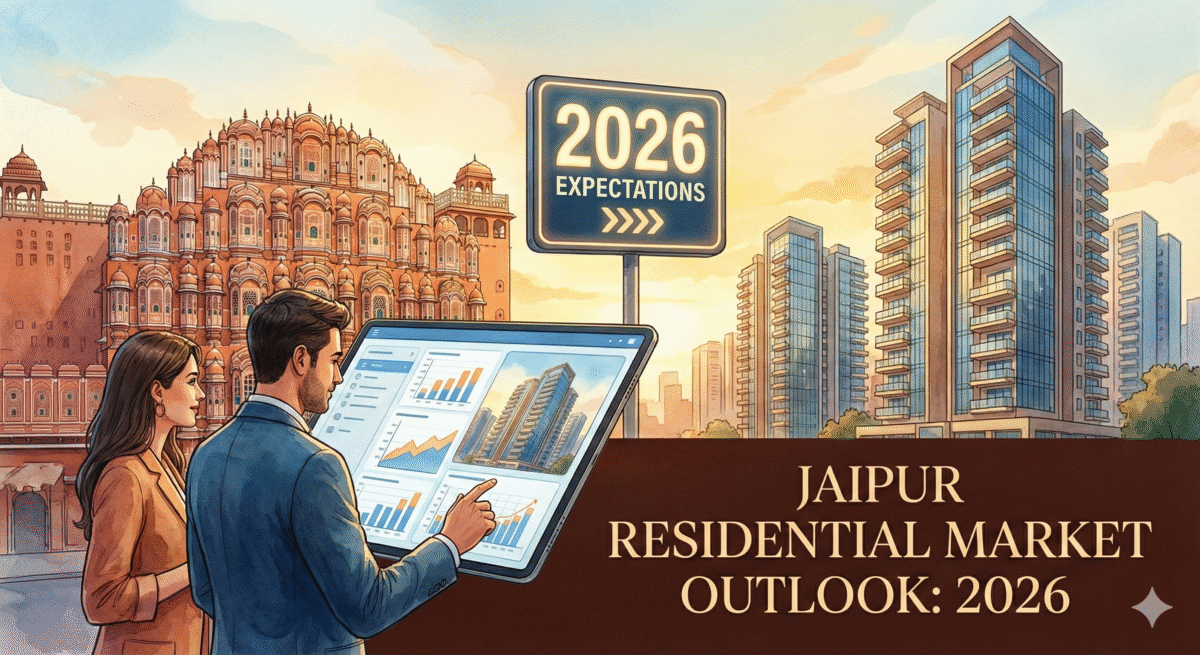
Jaipur’s residential real estate market has emerged as one of India’s most dynamic growth stories, and as we approach 2026, the Pink City shows no signs of slowing down. With impressive price appreciation, infrastructure expansion, and changing buyer preferences, homebuyers need to understand what lies ahead to make informed decisions.
Market Performance: A Record-Breaking Run
The Jaipur residential market has delivered exceptional performance in recent years. In 2024, the city recorded a 5% increase in housing sales, reaching 10,695 units. However, the more striking figure is the 39% surge in sales value, which jumped from ₹6,019 crore in 2023 to ₹8,388 crore in 2024. This disparity between volume and value growth indicates a clear shift toward premium and upscale housing projects.
The city has achieved a remarkable 98.2% property price growth, leading all Tier-2 cities in India’s real estate sector. Between 2023 and October 2024, Jaipur recorded a 65% increase in the weighted average price of new launch projects, rising from ₹4,240 to ₹6,979 per square foot.
These numbers reflect not just market momentum but fundamental demand drivers that are expected to sustain through 2026 and beyond.
Price Trends and Projections for 2026
Looking ahead to 2026, experts predict continued growth, albeit at a more moderate pace. Nationally, housing prices are expected to see a moderate single-digit increase in 2025, following a 21% rise in 2024. However, specific corridors in Jaipur may experience sharper appreciation.
Locality-Wise Price Indicators
Recent data reveals significant variations across different areas:
High Appreciation Zones (Last 3 Years):
- JLN Marg: 295.6% growth
- Ring Road: 241.7% growth
- Nirman Nagar: 75.0% growth
- Chitrakoot: 69.6% growth
Current Price Points:
- Ajmer Road: ₹18,000 per sq. meter with 26.3% year-over-year growth
- Jagatpura: ₹10,800 per sq. meter
- Affordable areas like Bagru Khurd: ₹1,550 per sq. ft.
Infrastructure Development: The Game Changer
Infrastructure projects are the primary catalyst driving Jaipur’s real estate transformation, and their impact will intensify through 2026.
Metro Expansion
The Rajasthan government announced a ₹12,000 crore allocation for metro expansion across multiple phases in early 2025. The proposed Orange Line will connect Ambabari to Sitapura Industrial Area, covering 23.5 km with 21 stations. Metro phase-2 is expected to connect key areas like Sitapura and Jaipur International Airport, covering residential, commercial, and industrial areas in Vidyanagar, with daily ridership projected to reach around 1.7 lakh.
For homebuyers, properties near metro corridors are expected to see substantial appreciation. The introduction of the metro system has contributed to rising property values near metro stations due to better accessibility, encouraging real estate development.
Connectivity Improvements
The Delhi-Mumbai Expressway, operational up to Dausa, has cut Delhi-Jaipur travel time from 5 hours to just about 3 hours. This improved connectivity has made Jaipur increasingly attractive to professionals who can maintain close links to the National Capital Region while enjoying lower living costs.
The Northern Jaipur Ring Road project, with an allocation of ₹6,500 crore, will enhance connectivity to suburbs like Jagatpura, Mansarovar, and Sirsi Road, making these areas prime investment zones for 2026.
Airport Expansion
Airport expansion construction has started, with a new terminal expected by 2026. This development will particularly benefit areas like Jagatpura, Mansarovar Extension, and Sanganer.
Emerging Hotspots for 2026
Based on current trends and infrastructure development, three corridors stand out for homebuyers considering purchases in 2026:
1. Mansarovar Extension
Mansarovar Extension offers lower property prices compared to inner Jaipur, yet appreciation trends remain consistently upward, with strong rental demand driven by educational institutions and corporate hubs. Recent flyover and road-widening projects, along with planned metro expansion, are transforming accessibility in this area.
2. Jagatpura
Once a quiet suburb, Jagatpura has transformed into one of Jaipur’s fastest-growing residential hubs. Property prices in Jagatpura have risen steadily, often delivering 20-25% growth annually in prime pockets. Its proximity to Jaipur International Airport, Sitapura Industrial Area, and medical and educational institutions makes it attractive for both end-users and investors.
3. Ajmer Road SEZ Belt
The Ajmer Road area’s transformation into a major employment and residential hub is attracting both working professionals and NRIs, with proximity to SEZ and corporate parks ensuring consistent housing demand and rental potential.
Segment-Wise Market Dynamics
Affordable Housing
The Rajasthan government, in collaboration with the central government, has launched various schemes under the Pradhan Mantri Awas Yojana (PMAY), with the Jaipur Development Authority (JDA) regularly floating housing schemes for economically weaker sections (EWS), low-income groups (LIG), and middle-income groups (MIG).
The PMAY-Urban 2.0 scheme, implemented for a period of 5 years from 2024 to 2029, provides Central Assistance of up to ₹2.50 lakh to eligible families belonging to EWS/LIG/MIG segments for constructing, purchasing, or renting affordable houses.
For first-time homebuyers, this presents significant opportunities, with income tax rate cuts introduced in the 2025-26 Union Budget expected to enhance middle-class disposable income and strengthen demand for affordable housing.
Luxury Housing Boom
The luxury segment is experiencing unprecedented growth. Jaipur’s real estate market is witnessing a rise in luxury housing projects catering to NRIs and high-net-worth individuals, with demand for premium apartments, villas, and gated communities rising as more professionals and NRIs look to invest in Jaipur.
Areas like Vaishali Nagar, C-Scheme, and Civil Lines are seeing significant demand for high-end properties with world-class amenities, including clubhouses, infinity pools, private gardens, and high-tech security systems.
Rental Market Outlook
For investors considering rental properties, Jaipur offers attractive yields. Vaishali Nagar Extension offers 5.8% rental returns, Vaishali Nagar offers 5.1%, while Bhankrota and Shri Kishanpura both offer 4.3% rental returns.
The growing population of students, IT professionals, and corporate workers continues to drive rental demand, particularly in areas with good connectivity to employment hubs and educational institutions.
Key Trends Shaping 2026
1. Smart and Sustainable Living
Buyers are increasingly prioritizing eco-friendly features. Developers are focusing on rainwater harvesting, solar panels, energy-efficient designs, and green building concepts. This trend aligns with Jaipur’s Smart City initiatives and will become more prominent in 2026.
2. Integrated Townships
The city’s population is projected to cross 6.5 million by 2025, fueling demand for quality housing, with buyers now looking for integrated communities with modern amenities rather than standalone homes. This shift toward self-contained townships offering residential, commercial, and recreational facilities within single developments will continue to gain momentum.
3. Technology Integration
Digital upgrades including QR-code based ticketing, real-time train updates, and app-based journey planners are in development. Similarly, residential projects are increasingly incorporating smart home technologies, advanced security systems, automated climate control, and voice-activated features.
4. NRI Investment
Digitization, new neighborhoods, and a spike in NRI interest are among the main factors driving real estate investment in Jaipur in 2025. This trend is expected to strengthen in 2026, particularly in premium segments and areas with strong rental yields.
Challenges Homebuyers Should Consider
While the outlook is positive, prospective buyers should be aware of certain challenges:
Construction Delays: Infrastructure projects sometimes face land acquisition and regulatory hurdles that can cause delays. Buyers should verify project timelines and developer credibility before committing.
Price Volatility: Rapidly appreciating areas may experience price corrections if demand doesn’t keep pace with supply.
Infrastructure Dependency: Properties in emerging areas are heavily dependent on promised infrastructure completion. Delays in metro or road projects can impact both appreciation and livability.
RERA Compliance: Always verify that projects are registered under the Real Estate Regulatory Authority (RERA) to ensure transparency and accountability.
Strategic Recommendations for 2026 Homebuyers
For First-Time Buyers
- Consider Emerging Areas: Locations like Mansarovar Extension and Jagatpura offer better affordability with strong appreciation potential.
- Leverage Government Schemes: Take advantage of PMAY-U 2.0 subsidies and income tax benefits to reduce the financial burden.
- Prioritize Connectivity: Choose properties with current or planned metro connectivity and proximity to employment hubs.
- Verify Legal Compliance: Ensure all necessary approvals are in place and the project is RERA-registered.
For Investors
- Focus on Infrastructure Corridors: Properties near metro stations, ring roads, and expressways will offer the highest appreciation.
- Evaluate Rental Potential: Areas near IT parks, educational institutions, and SEZ zones provide stable rental income.
- Diversify by Segment: Consider a mix of affordable and mid-segment properties to balance risk and returns.
- Long-Term Perspective: Investors with a 7-10 year horizon can potentially double their investment value by carefully selecting the right residential location.
For End-Users
- Balance Location and Amenities: While central locations offer convenience, peripheral areas provide more space and modern amenities at lower costs.
- Consider Future Needs: With remote work becoming more common, prioritize spacious homes with dedicated work areas.
- Evaluate Developer Reputation: Choose established developers with a track record of timely delivery and quality construction.
- Assess Lifestyle Requirements: Look for projects that offer the amenities and community features that match your lifestyle preferences.
Conclusion: The 2026 Opportunity
Jaipur’s residential market stands at an exciting inflection point as we approach 2026. The combination of robust infrastructure development, strong demand fundamentals, government support for housing, and increasing interest from both domestic and international buyers creates a compelling environment for homeownership and investment.
Between 2023 and 2024, housing sales across 15 tier-II cities grew by 4%, totaling 1,78,771 units, while sales value saw a significant 20% jump, reaching ₹1,52,552 crore from ₹1,27,505 crore. Jaipur has been a significant contributor to this growth and is well-positioned to continue its upward trajectory.
For homebuyers, 2026 presents opportunities across all segments—from affordable housing under government schemes to luxury developments catering to discerning buyers. The key to success lies in thorough research, understanding location-specific dynamics, verifying legal compliance, and aligning purchase decisions with both current needs and future infrastructure development plans.
Whether you’re a first-time buyer looking for an affordable home, an investor seeking rental income, or an end-user wanting a premium lifestyle, Jaipur’s residential market in 2026 offers something for everyone. The Pink City’s perfect blend of heritage charm and modern infrastructure makes it not just a place to invest, but a place to call home.
Note: All data and statistics cited in this article are based on industry reports, government sources, and real estate market research conducted through 2024-2025. Prospective buyers should conduct independent due diligence and consult with qualified real estate professionals before making investment decisions.